Introduction
There has been a significant announcement from the Immigration Services Agency of Japan (ISA) that will impact those aiming for the “Specified Skilled Worker (ii)” (SSW (ii)) status and the companies that employ them.
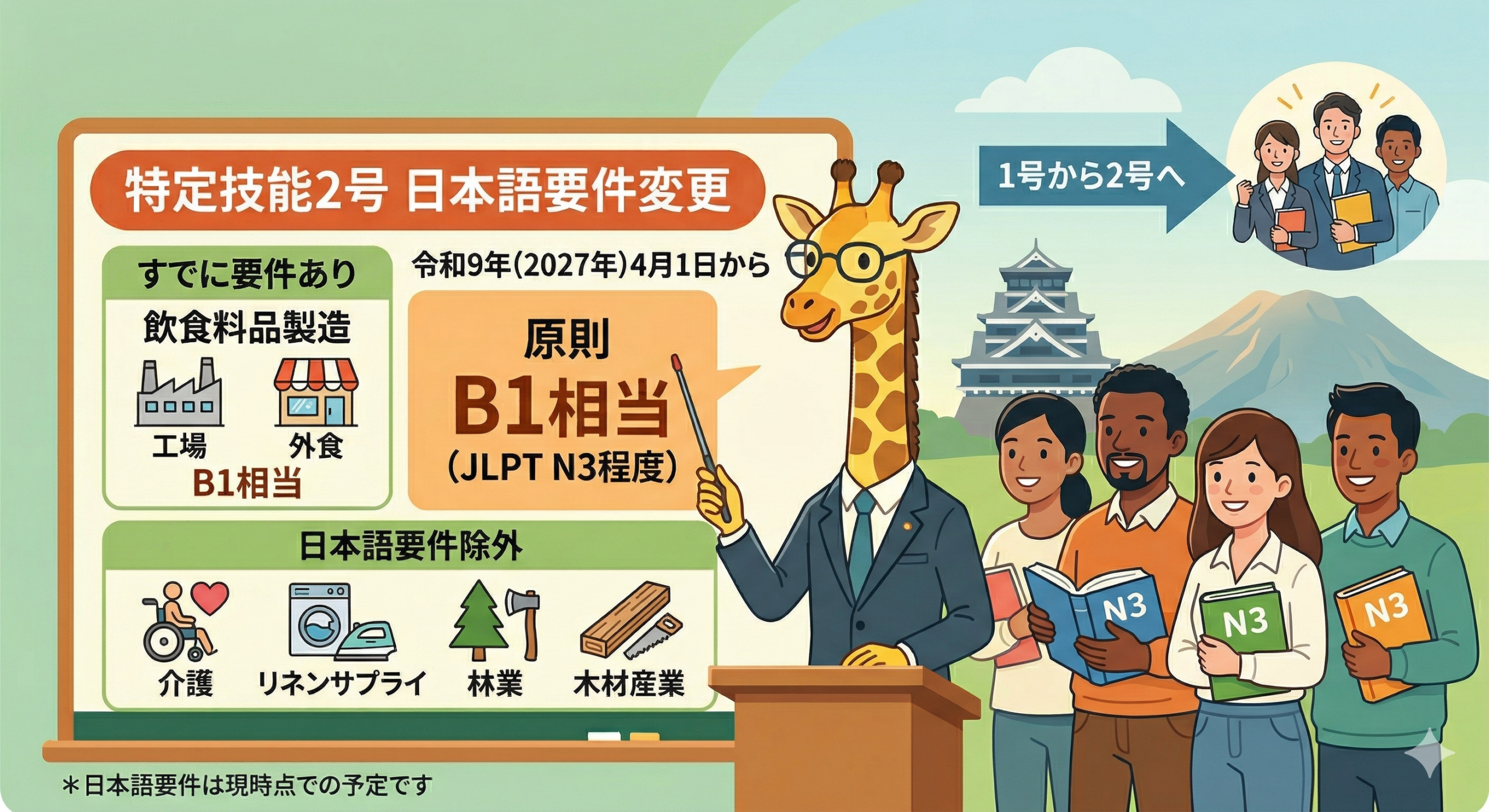
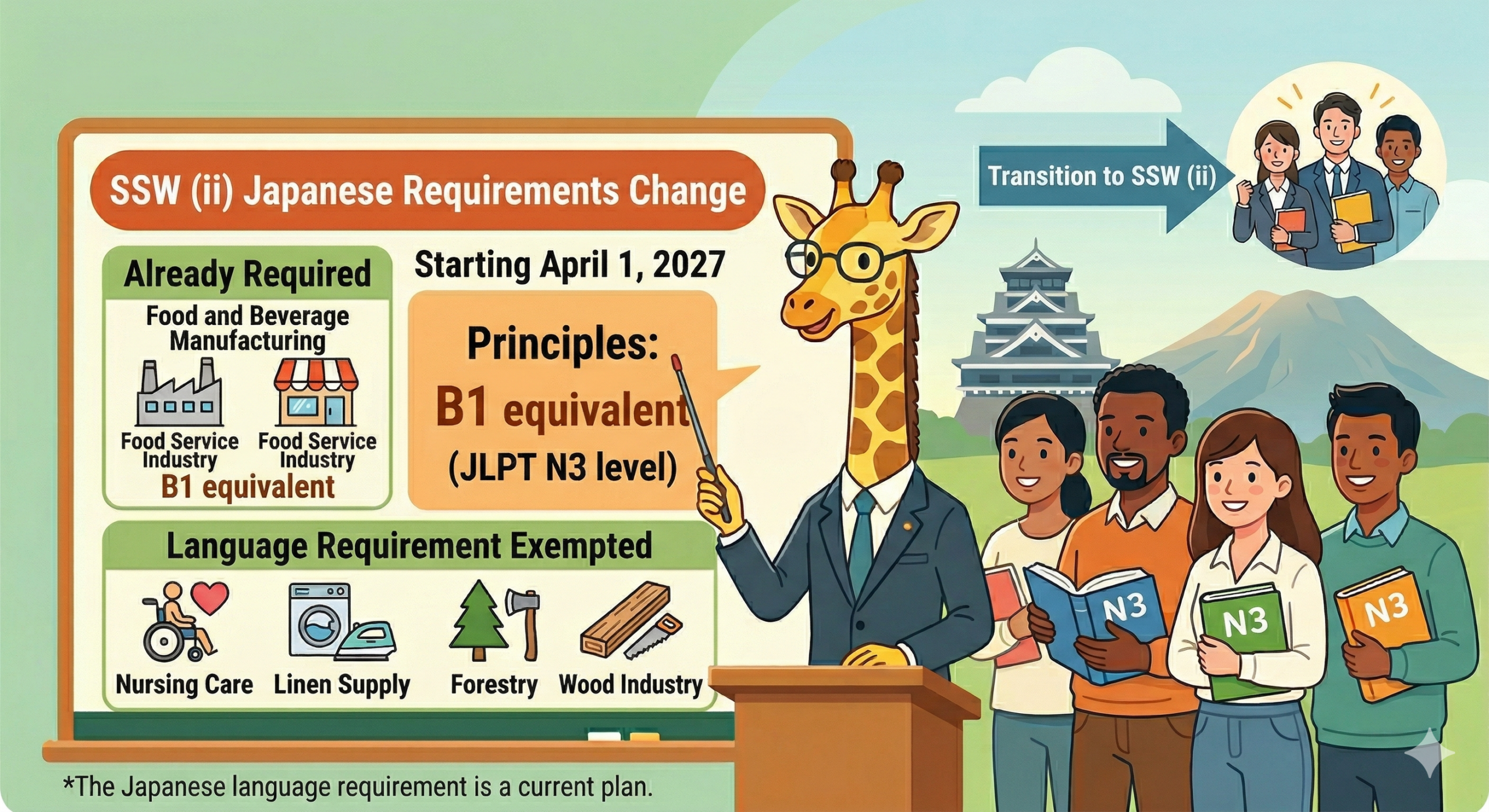
As of April 1, 2027 (Reiwa 9), it is planned that a Japanese language proficiency of “B1 level or higher” will be added as a mandatory requirement for transitioning to SSW (ii).
In this article, we will explain the details of this new requirement and the specific industries that are exempt from this change.
1. “B1 Level” Requirement Starting April 2027
Currently, transitioning to SSW (ii) requires high-level professional skills, but explicit Japanese language test results were not required for most industries.
However, starting April 1, 2027, applicants will, in principle, be required to prove a Japanese language proficiency of “B1 level or higher.”
What is “B1 Level”?
“B1” is a level defined by the Common European Framework of Reference for Languages (CEFR). When converted to the Japanese Language Proficiency Test (JLPT), it is approximately equivalent to “N3 level.”
| CEFR Level | Proficiency Description | JLPT Equivalent |
| B1 Level | Can understand the main points of clear standard input on familiar matters regularly encountered in work, school, leisure, etc. | Around N3 |
Applicants will need to demonstrate their ability as an “independent language user,” which is one step higher than the N4 level required for SSW (i).
2. Industries Where “B1 Level” is Already Required
Please note that the following two industries already require “B1 level or higher” for SSW (ii) status:
- Food and Beverage Manufacturing
- Food Service Industry
If you are aiming for SSW (ii) in these fields, high Japanese proficiency is required even at the present time.
3. Industries Exempt from the New Requirement
Due to the specific nature of the work or existing evaluation standards, the following four industries are currently exempt from the new “B1 level” requirement:
- Nursing Care (Careworker)
- Linen Supply (Cleaning sector)
- Forestry
- Wood Industry
For these sectors, the new B1 requirement is not planned to be imposed at this stage.
4. Information Source and Important Note
This information is based on documents released by the Immigration Services Agency of Japan (ISA).
Reference Resource:
Immigration Services Agency: Specified Skilled Worker Program (Link)
Please refer to the “PDF document dated March 27, 2026“ on the above page.
【Important】 This is currently a “Plan”
Please keep in mind that this addition of the Japanese language requirement is currently a “planned implementation” starting April 2027. Details of the system may change, or more specific methods of proof may be designated in the future.
In our support work with specified skilled worker candidates, we already see a mix of reactions to this planned requirement: some workers assume it will definitely apply to them and start JLPT study right away, while others assume nothing has been decided and take no action at all. In practice, we recommend treating your Japanese level as something worth improving regardless of whether this specific rule is finalized, since it also affects daily communication at work and, in many cases, your options for renewal or job change even under the current rules.
Conclusion
The SSW (ii) status is a major milestone for foreign workers, offering benefits such as the ability to bring family members and no limit on the number of residency renewals. To prepare for the stricter requirements, it is crucial to start planning your language studies and career path early.
At our office, we provide not only application support for Specified Skilled Workers but also professional advice regarding legal and systemic changes. If you have any concerns, please feel free to contact us.
Facebook Messenger:Please send a message to our official Facebook page(https://www.facebook.com/profile.php?id=61587057572424)
Written by Ryuichi Otsuka, Certified Administrative Scrivener (Registration No. 25436451, Kumamoto Prefecture), Representative of Office Kirin. View office profile

Questions about SSW visa language requirements?
Office Kirin (行政書士事務所きりん) helps foreign workers and employers navigate SSW visa applications and requirement changes. Feel free to reach out.
You can also send us a message on Facebook
▶ Opening a restaurant or food manufacturing business in Japan? Food and beverage industries already require B1-level Japanese for SSW (ii), and business licensing is a related hurdle — see our food business license guide Office Kirin